Vaporized Heat Collection Types
1. In this context, a refrigerant is classified to be a liquid that can evaporate and turn into a vapor at or above a given temperature that is specific to that liquid. It thereby extracts heat from it's environment mainly by way of conduction.
2. Diagram 134a above shows the characteristic curve of a liquid whose liquid to gas and gas to liquid phase change is used to collect heat.
3. In the diagram, the amount of heat that can be collected and moved to another place is given in kJ/kg.
4. The temperature of 1kg of the said liquid is thereby increased from 12ºC to 60ºC..
5. The energy thereby collected by 1kg of the substance is 32kJ.
Alcohol Types As heat conducting liquids.
1. Tetradecane Boiling Point: 257°C
2. Propane-1,2,3-triol Boiling Point: 290°C
3. Glycerol Boiling Point: 290°C
4. 1-Butanol Boiling Point: 118°C
5. Perchlorethylene Boiling Point: 121°C
6. 1-Pentanol Boiling Point: 138°C
7. Hydrogen Peroxide Boiling Point: 150°C
8. N-nonane Boiling Point: 151°C
9. Turpentine Boiling Point 160°C
10. 2-Heptanol Boiling Point 160°C
11. Furfurol Boiling Point: 162°C
12. Furfuryl Alcohol Boiling Point: 170°C
13. Alcohol Boiling Point: 78°C Eg.: Cassava Ethanol
14. Ethanol 2.1 bar @ 100°C.
15. Vapor Pressure 1-Butanol 2.8 bar @ 150°C
16. Vapor Pressure DMF 2.6 bar @ 190°C
17. Vapor Pressure Steam 3.8 bar @ 150°C
18. Vapor Pressure Methanol 8.9 bar @ 150°C
19. Table Of Others 1
20. Table Of Others 2 (Melting Point (MP) Boiling Point (BP))
21. Table Of Others 3
1. In this context, a refrigerant is classified to be a liquid that can evaporate and turn into a vapor at or above a given temperature that is specific to that liquid. It thereby extracts heat from it's environment mainly by way of conduction.
2. Diagram 134a above shows the characteristic curve of a liquid whose liquid to gas and gas to liquid phase change is used to collect heat.
3. In the diagram, the amount of heat that can be collected and moved to another place is given in kJ/kg.
4. The temperature of 1kg of the said liquid is thereby increased from 12ºC to 60ºC..
5. The energy thereby collected by 1kg of the substance is 32kJ.
Alcohol Types As heat conducting liquids.
1. Tetradecane Boiling Point: 257°C
2. Propane-1,2,3-triol Boiling Point: 290°C
3. Glycerol Boiling Point: 290°C
4. 1-Butanol Boiling Point: 118°C
5. Perchlorethylene Boiling Point: 121°C
6. 1-Pentanol Boiling Point: 138°C
7. Hydrogen Peroxide Boiling Point: 150°C
8. N-nonane Boiling Point: 151°C
9. Turpentine Boiling Point 160°C
10. 2-Heptanol Boiling Point 160°C
11. Furfurol Boiling Point: 162°C
12. Furfuryl Alcohol Boiling Point: 170°C
13. Alcohol Boiling Point: 78°C Eg.: Cassava Ethanol
14. Ethanol 2.1 bar @ 100°C.
15. Vapor Pressure 1-Butanol 2.8 bar @ 150°C
16. Vapor Pressure DMF 2.6 bar @ 190°C
17. Vapor Pressure Steam 3.8 bar @ 150°C
18. Vapor Pressure Methanol 8.9 bar @ 150°C
19. Table Of Others 1
20. Table Of Others 2 (Melting Point (MP) Boiling Point (BP))
21. Table Of Others 3
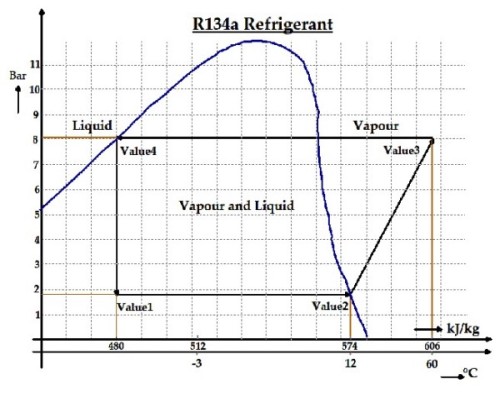
Diagram 134a
- Parametric Data