Power Rail (PR):
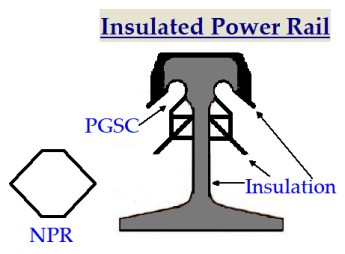
Insulation Roof
Power Grabber Slide Channel (PGSC)
1. This is a third rail that is installed so that it can provide electric power to a moving train.
2. For the purpose of simplicity and low cost, this component can be a standard rail that is machined approximately as shown in the diagram.
3. The height of this rail from the ground will be defined by the diameter of the train wheels, so that the Power Grabber can be kept a maximum height from the ground.
4. That height might be up to 0.6m from the ground.
5. It is not recommended that rules and regulations be simply taken over from other countries and implemented on African railway lines, because those countries may have reasons that do not exist in Africa for implementing them.
6. That means that plenty of flyovers or under passes are better for Africa than overhead poles every 10 or 20 meters.
7. Not to mention the problem and construction cost of trying to change direction while connected to overhead lines.
8. If there are elephants in the area, fencing will not stop them, but steep embankments may be useful.
9. If there are goats in the area, nothing will stop them, except fencing or crossovers with plenty of grass and water to distract their attention from the lines.
10. Apart from the fact that a power rail can be a piece of modified track and is therefore very strong and rigid, due to it's large cross section, it will have quite a low electrical resistance, up to a certain length that is measured in kilometers and thereby have good electric current carrying capability.
11. Everything on this rail, including it's mounting is insulated such that water will pearl off it.
How the Power Rail (PR) Works:
1. Due to it's ability to carry heavy weights:
A. Three phase current carriers can be mounted on it's under side, thereby saving a huge amount of infrastructure cable cost.
B. One does not really want to transform the voltage down that a train carriage gets from the three phase power carrier, because that would mean that only a switch and rectifier would be required in order to get the power from the three phase current carriers that are mounted underneath it to the said Power Rail (PR).
2. A Power Rail (PR) is split into sections that are fed with electric power from a Transformer and Switch (TSW).
3. The electric power is fed to a section of the Power Rail (PR) when a train is on it.
4. The power is removed when the train leaves that section of track.
The Transformer and Switch (TSW) are not only where the (SHE) is connected to it, they can be in any position along any stretch of track.
5. They thereby serve to keep those parts of the Power Rail (PR) that do not have a train running on them free of electric power, which increases the all round safety margin with respect to high voltage on unattended lines.
6. The Transformer and Switch (TSW) combinations being talked about here will not be as complicated as the ones with an entry for the SHE power supply.
7. Their input power will be from the Power Cable (PC).
8. An active track is a stretch of track that has power on the Power Rail (PR).
9. A passive track is a stretch of track that does not have any power on the Power Rail (PR).
10. The power ON/OFF coordination on the Power Rail (PR) is carried out using the Photoelectric Detector (PED).
11. Power Rail (PR) are not used in the vicinity of train stops and maintenance yards, even if they continue supporting the weight of the power carriers.
12. All trains will use their built in battery that is charged while running on an active Power Rail (PR).
Collecting the Other Types of Customers One by One
1. There are already diesel electric heavy goods trains and the time may come when they will also want to use the Power Rail (PR) in order to reduce their running cost.
2. Only a relative small amount of hardware would be required inside such trains in order to give them the capability to connect to the Power Rail (PR) and thereby transport goods through a given country at a price that is lower than that of diesel electric.
Insulation Roof
Power Grabber Slide Channel (PGSC)
1. This is a third rail that is installed so that it can provide electric power to a moving train.
2. For the purpose of simplicity and low cost, this component can be a standard rail that is machined approximately as shown in the diagram.
3. The height of this rail from the ground will be defined by the diameter of the train wheels, so that the Power Grabber can be kept a maximum height from the ground.
4. That height might be up to 0.6m from the ground.
5. It is not recommended that rules and regulations be simply taken over from other countries and implemented on African railway lines, because those countries may have reasons that do not exist in Africa for implementing them.
6. That means that plenty of flyovers or under passes are better for Africa than overhead poles every 10 or 20 meters.
7. Not to mention the problem and construction cost of trying to change direction while connected to overhead lines.
8. If there are elephants in the area, fencing will not stop them, but steep embankments may be useful.
9. If there are goats in the area, nothing will stop them, except fencing or crossovers with plenty of grass and water to distract their attention from the lines.
10. Apart from the fact that a power rail can be a piece of modified track and is therefore very strong and rigid, due to it's large cross section, it will have quite a low electrical resistance, up to a certain length that is measured in kilometers and thereby have good electric current carrying capability.
11. Everything on this rail, including it's mounting is insulated such that water will pearl off it.
How the Power Rail (PR) Works:
1. Due to it's ability to carry heavy weights:
A. Three phase current carriers can be mounted on it's under side, thereby saving a huge amount of infrastructure cable cost.
B. One does not really want to transform the voltage down that a train carriage gets from the three phase power carrier, because that would mean that only a switch and rectifier would be required in order to get the power from the three phase current carriers that are mounted underneath it to the said Power Rail (PR).
2. A Power Rail (PR) is split into sections that are fed with electric power from a Transformer and Switch (TSW).
3. The electric power is fed to a section of the Power Rail (PR) when a train is on it.
4. The power is removed when the train leaves that section of track.
The Transformer and Switch (TSW) are not only where the (SHE) is connected to it, they can be in any position along any stretch of track.
5. They thereby serve to keep those parts of the Power Rail (PR) that do not have a train running on them free of electric power, which increases the all round safety margin with respect to high voltage on unattended lines.
6. The Transformer and Switch (TSW) combinations being talked about here will not be as complicated as the ones with an entry for the SHE power supply.
7. Their input power will be from the Power Cable (PC).
8. An active track is a stretch of track that has power on the Power Rail (PR).
9. A passive track is a stretch of track that does not have any power on the Power Rail (PR).
10. The power ON/OFF coordination on the Power Rail (PR) is carried out using the Photoelectric Detector (PED).
11. Power Rail (PR) are not used in the vicinity of train stops and maintenance yards, even if they continue supporting the weight of the power carriers.
12. All trains will use their built in battery that is charged while running on an active Power Rail (PR).
Collecting the Other Types of Customers One by One
1. There are already diesel electric heavy goods trains and the time may come when they will also want to use the Power Rail (PR) in order to reduce their running cost.
2. Only a relative small amount of hardware would be required inside such trains in order to give them the capability to connect to the Power Rail (PR) and thereby transport goods through a given country at a price that is lower than that of diesel electric.
App. Diagram 2