Design Strategy - Judging The Size of a Solar Heat Engine (SHE)
Land Area Sizes
1 acre = 4046.8m²
1 hectare = 10000m² = 2.47 acre
Average Solar Radiation
Around the tropic of cancer and tropic of capricorn: 4.5 (kWh.day)/m²
In and around deserts: 7.5 (kWh.day)/m².
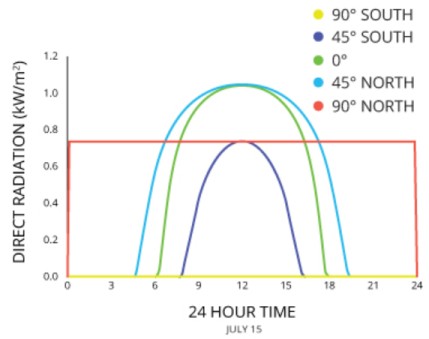
Peak Solar Radiation Graph
Solar to electricity Efficiency
Standard Design Dependant: 50%
SHE Design Dependant : 87.5%
Concentrator Size Compensation for standard efficiency loss would in the first instance become:
1m²/ 0.5 = 2m² for
4.5 kWh/m²/day and 7.5 kWh/m²/day
Estimating Travel Distance vs. m²
If a passenger requires 10Wh/km (design dependent) of energy, the 2m² of concentrator will allow that same passenger to travel: 4.5kWh/10Wh/km = 450km.
For a 50km round trip per person:
10Wh/km * 50km = 500Wh
That means that 2m² of concentrator would allow 4.5kWh /500Wh/person = 9 persons
to make the 50km round trip each day.
Start Up Example:
For start up example purposes, the output power of the SHE is defined to be 100kWh.
The main support of this project is the availability of trains, passengers, businesses as well as housing, therefore the idea here is not to take on credit whose value can not yet be estimated fully, but to reserve the ability to get the required amount of working capital when required.
Calculation Size 1:
A. Start amount 100kWh
B. The 100kWh/500Wh/person = 200 persons on the 50km round trip per day.
C. Taking into account the SHE internal losses, (100kWh/4.5kWh/m²) * 2 = 44.44m² of solar concentrators for the first start up day.
D. Amount to be collected 100kWh * 2 = 200kWh
E. At 70% efficiency: 200kWh * 0.7 = 140kWh to the heat storage.
For easy over sight, add passengers in steps of 200 more per hour up to 4 times for the hour.
Calculation Size 2:
A. 4 trips/hr * 100kWh/day = 400kWh/day
B. 4 trips/hr * 200persons/day = 800persons on the 50km round trip per day.
C. 4 trips/hr * 44.44m² = 177,76m² concentrator area.
D. Amount to be collected 400kWh * 2 = 800kWh
E. At 70% efficiency: 800kWh * 0.7 = 560kWh to the heat storage.
For starters, daylight operation only, add the number of hours use in steps of 2 hours for 6 hours.
Two hours in the morning, two in the evening and two during the day.
Calculation Size 3:
A. 4 trips/hr * 100kWh/day * 6hr = 2400kWh/day
B. 4 trips/hr * 200persons/day * 6hr = 4800persons on the 50km round trip per day.
C. 4 trips/hr * 44.44m² * 6hr = 1066.6m² concentrator area.
D. Amount to be collected 2400kWh * 2 = 4800kWh
E. At 70% efficiency: 4800kWh * 0.7 = 3360kWh to the heat storage.
Even with maximum solar concentrator spacing, a 4 acre piece of land could produce upwards of 4 * 2400kWh/day = 9600kWh/day.
That fits the African electrification plan quite nicely, because it includes room for expanding railway, industrial and home energy consumption.
Price Example:
Using components from emerging markets and depending on the real African world situation on the ground when the plan is implemented to the level specified above, at 1$ per 50km round trip, that would be $4800 per day to be shared between all the sections involved in the railway line operation.
The (SHE) design dependant efficiency of 87.5% will allow the same running costs for about 40% more output power.
Furthermore, the real average solar radiation between 35º north and 35º south is about 5.5 kWh/m²/day.
That is an expected further (5.5kWh - 4.5kWh)/4.5kWh *100% = 22% increase in solar energy input for the same amount of solar concentrator area.
That extra amount of energy has been left out of the calculation here, so that it can be passed on to households that use most of their energy after 1800 hours.
In fact it could be made common practice to let households charge up a few kWh of battery energy at home during peak solar power periods when trains may not be running at full power load.
When looking at the average income of certain African countries, it may well be necessary for those governments to subsidize the passenger fare until a time when the personal income level of the passengers will allow them to be slowly withdrawn.
If needed, add more solar concentrator area, for the other parts of the project that also need electric power.
Estimated Total Project Cost for 2400kWh/day Power from (SHE)
From System Advisor Model
Field Size Project Cost
965,632m² $ 838,519,717
Scale down price for this size Project
Field Size Basic Project Cost
1066.6m² 1066.6m²/965,632m² * $ 838,519,717
= $ 925,676
In this author's opinion, Africa is third world, therefore it's price factor compared with industrialize countries is:
First World (FW) Second world (SW) Third world (TW)
1 1/2* (FW) = 1/2 1/2* (SW) = 1/4
Price Adjusted for Africa:
Field Size Africa Project Cost
1066.6m² $ 926,544* 1/2 = $ 463,272
1066.6m² $ 926,544* 1/4 = $ 231,419
The Turbine might be the main thing that is not yet available in Africa, but a cheaper one that local personnel can build and maintain will give the project an head start.
Most other visible components can be constructed in a workshop or small factory, which will make the man on the street a stake holder.
Contrary to common belief, the land area required to build a concentrating solar power plant is not more than for other types of power stations.
The main reason for such a situation is that the safety area required by other types of power plants is in reality more than the collecting area required for equivalent sized solar power plants.
Land Area Sizes
1 acre = 4046.8m²
1 hectare = 10000m² = 2.47 acre
Average Solar Radiation
Around the tropic of cancer and tropic of capricorn: 4.5 (kWh.day)/m²
In and around deserts: 7.5 (kWh.day)/m².
Peak Solar Radiation Graph
Solar to electricity Efficiency
Standard Design Dependant: 50%
SHE Design Dependant : 87.5%
Concentrator Size Compensation for standard efficiency loss would in the first instance become:
1m²/ 0.5 = 2m² for
4.5 kWh/m²/day and 7.5 kWh/m²/day
Estimating Travel Distance vs. m²
If a passenger requires 10Wh/km (design dependent) of energy, the 2m² of concentrator will allow that same passenger to travel: 4.5kWh/10Wh/km = 450km.
For a 50km round trip per person:
10Wh/km * 50km = 500Wh
That means that 2m² of concentrator would allow 4.5kWh /500Wh/person = 9 persons
to make the 50km round trip each day.
Start Up Example:
For start up example purposes, the output power of the SHE is defined to be 100kWh.
The main support of this project is the availability of trains, passengers, businesses as well as housing, therefore the idea here is not to take on credit whose value can not yet be estimated fully, but to reserve the ability to get the required amount of working capital when required.
Calculation Size 1:
A. Start amount 100kWh
B. The 100kWh/500Wh/person = 200 persons on the 50km round trip per day.
C. Taking into account the SHE internal losses, (100kWh/4.5kWh/m²) * 2 = 44.44m² of solar concentrators for the first start up day.
D. Amount to be collected 100kWh * 2 = 200kWh
E. At 70% efficiency: 200kWh * 0.7 = 140kWh to the heat storage.
For easy over sight, add passengers in steps of 200 more per hour up to 4 times for the hour.
Calculation Size 2:
A. 4 trips/hr * 100kWh/day = 400kWh/day
B. 4 trips/hr * 200persons/day = 800persons on the 50km round trip per day.
C. 4 trips/hr * 44.44m² = 177,76m² concentrator area.
D. Amount to be collected 400kWh * 2 = 800kWh
E. At 70% efficiency: 800kWh * 0.7 = 560kWh to the heat storage.
For starters, daylight operation only, add the number of hours use in steps of 2 hours for 6 hours.
Two hours in the morning, two in the evening and two during the day.
Calculation Size 3:
A. 4 trips/hr * 100kWh/day * 6hr = 2400kWh/day
B. 4 trips/hr * 200persons/day * 6hr = 4800persons on the 50km round trip per day.
C. 4 trips/hr * 44.44m² * 6hr = 1066.6m² concentrator area.
D. Amount to be collected 2400kWh * 2 = 4800kWh
E. At 70% efficiency: 4800kWh * 0.7 = 3360kWh to the heat storage.
Even with maximum solar concentrator spacing, a 4 acre piece of land could produce upwards of 4 * 2400kWh/day = 9600kWh/day.
That fits the African electrification plan quite nicely, because it includes room for expanding railway, industrial and home energy consumption.
Price Example:
Using components from emerging markets and depending on the real African world situation on the ground when the plan is implemented to the level specified above, at 1$ per 50km round trip, that would be $4800 per day to be shared between all the sections involved in the railway line operation.
The (SHE) design dependant efficiency of 87.5% will allow the same running costs for about 40% more output power.
Furthermore, the real average solar radiation between 35º north and 35º south is about 5.5 kWh/m²/day.
That is an expected further (5.5kWh - 4.5kWh)/4.5kWh *100% = 22% increase in solar energy input for the same amount of solar concentrator area.
That extra amount of energy has been left out of the calculation here, so that it can be passed on to households that use most of their energy after 1800 hours.
In fact it could be made common practice to let households charge up a few kWh of battery energy at home during peak solar power periods when trains may not be running at full power load.
When looking at the average income of certain African countries, it may well be necessary for those governments to subsidize the passenger fare until a time when the personal income level of the passengers will allow them to be slowly withdrawn.
If needed, add more solar concentrator area, for the other parts of the project that also need electric power.
Estimated Total Project Cost for 2400kWh/day Power from (SHE)
From System Advisor Model
Field Size Project Cost
965,632m² $ 838,519,717
Scale down price for this size Project
Field Size Basic Project Cost
1066.6m² 1066.6m²/965,632m² * $ 838,519,717
= $ 925,676
In this author's opinion, Africa is third world, therefore it's price factor compared with industrialize countries is:
First World (FW) Second world (SW) Third world (TW)
1 1/2* (FW) = 1/2 1/2* (SW) = 1/4
Price Adjusted for Africa:
Field Size Africa Project Cost
1066.6m² $ 926,544* 1/2 = $ 463,272
1066.6m² $ 926,544* 1/4 = $ 231,419
The Turbine might be the main thing that is not yet available in Africa, but a cheaper one that local personnel can build and maintain will give the project an head start.
Most other visible components can be constructed in a workshop or small factory, which will make the man on the street a stake holder.
Contrary to common belief, the land area required to build a concentrating solar power plant is not more than for other types of power stations.
The main reason for such a situation is that the safety area required by other types of power plants is in reality more than the collecting area required for equivalent sized solar power plants.